Multi-Platform Mobile Strategy with Flutter
In an environment where mobile applications drive enterprise growth, deploying to both iOS and Android simultaneously is mandatory. Traditional dual-codebase approaches double development costs, fragment engineering bandwidth, and delay feature releases. Conversely, legacy web-view hybrid wrappers often yield poor frame rates and non-native UI behavior.
Implementing Flutter Cross-Platform Development solves these challenges by compiling Dart source code into native ARM machine code without relying on JavaScript bridges. Driven by high-performance graphics engines (Impeller and Skia), Flutter delivers 60 to 120 FPS rendering while enabling up to 90% shared code logic across platforms. Partnering with a dedicated Flutter Cross-Platform Development agency allows enterprise organizations to maintain pixel-perfect UI designs, lower total cost of ownership (TCO), and accelerate product launches.
Architectural Deep-Dive: Impeller/Skia Engine & Dart Runtime
Flutter bypasses platform-native UI widgets in favor of direct canvas rendering. Understanding this engine-level pipeline clarifies why Flutter maintains sub-second rendering speeds.
- Custom Graphics Pipeline: Flutter draws UI components pixel-by-pixel directly onto GPU surfaces via Metal (iOS) or Vulkan/OpenGL (Android). This eliminates UI discrepancies caused by platform update variances.
- AOT & JIT Compilation: During development, Dart utilizes Just-In-Time (JIT) compilation to support Hot Reloading within milliseconds. For production, Dart compiles Ahead-Of-Time (AOT) into native machine code, optimizing startup time and overall execution speed.
- Native Platform Channels: When accessing device hardware (such as Bluetooth, NFC, or Biometrics), Flutter invokes MethodChannel asynchronous messages to communicate directly with Swift/Objective-C or Kotlin/Java host APIs.
Cross-Platform Framework Matrix: Flutter vs. React Native vs. Native
Choosing the correct cross-platform foundation requires evaluating rendering approaches, ecosystem capabilities, and long-term codebase maintainability.
Enterprise State Management Frameworks
Scalable Flutter Cross-Platform Development requires structured state management patterns to cleanly separate UI presentation layers from core domain logic.
- BLoC (Business Logic Component) Pattern: Utilizes reactive streams (Streams and Sinks) to separate UI widgets from business logic. User interactions emit Events, and the BLoC processes business rules to emit updated States to the UI cleanly.
- Riverpod Framework: A compile-safe state management library that provides reactive dependency injection without relying on Flutter's BuildContext tree, simplifying unit and integration testing workflows.
- Repository Layer: Decouples remote HTTP data fetching from local cache storage, maintaining clean data hydration pipelines across screen contexts.
Security, Hardware Integration & API Connectivity
Enterprise applications built with Flutter Cross-Platform Development mandate robust security profiles and low-latency API communication.
- Secure Hardware-Backed Storage: Tokens, key-value data, and credentials are encrypted using flutter_secure_storage, mapping directly to iOS Keychain and Android KeyStore (AES-256 encryption).
- SSL Pinning & Dio Network Layer: Network security is managed through custom Dio HTTP adapters that execute explicit SSL Certificate Pinning, preventing Man-in-the-Middle (MitM) attacks during API transport.
- Code Obfuscation & Binary Hardening: Pre-compilation flags shrink and obfuscate Dart symbol names within output IPA and APK/AAB files, protecting proprietary business logic against reverse engineering.
Continuous Integration, Automated Testing, and App Store Publishing
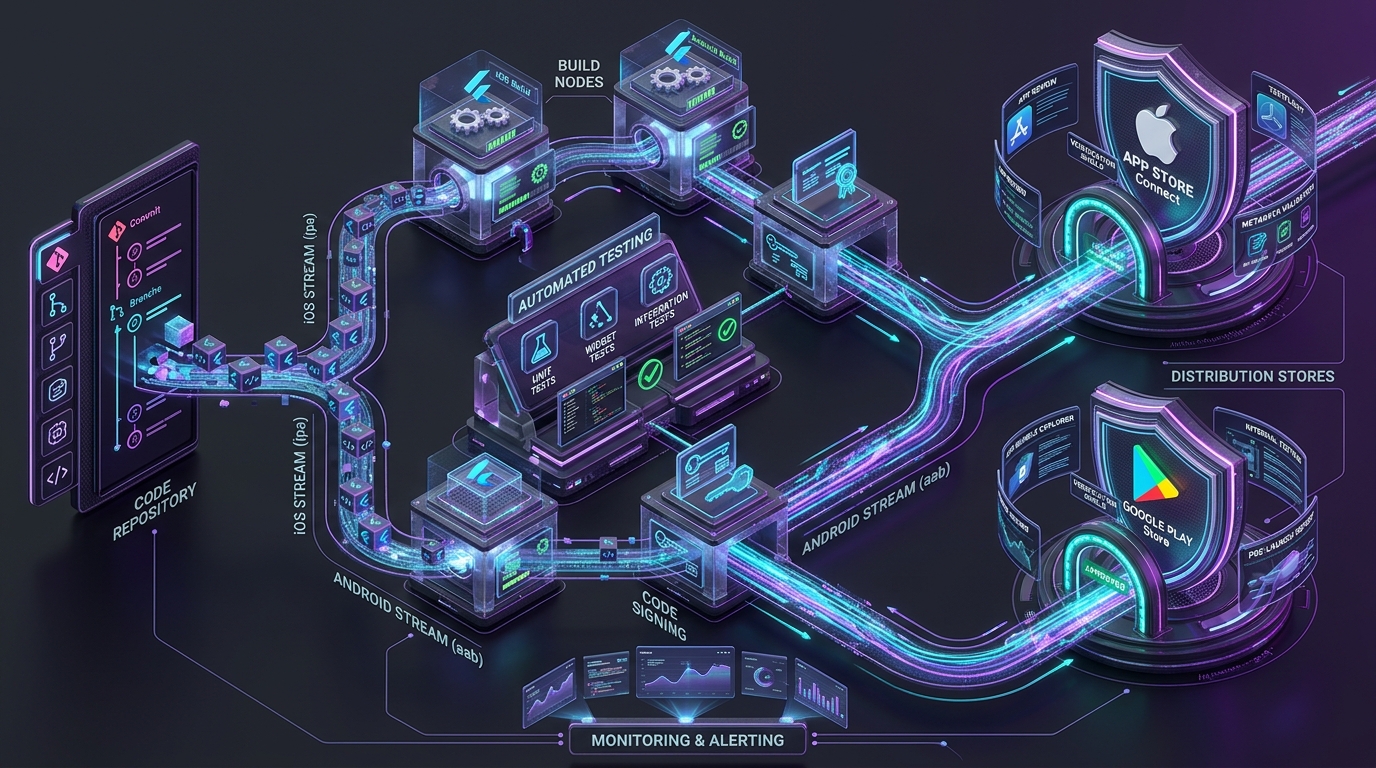
Delivering continuous updates to app stores demands automated deployment pipelines.
- Automated Testing Suite: Projects maintain comprehensive test pipelines incorporating Flutter Unit Tests (domain logic), Widget Tests (UI component interaction), and Integration Tests (end-to-end device workflows).
- Automated CI/CD Workflows: Workflows run through Fastlane, GitHub Actions, or Codemagic to handle code signing, automated versioning, build artifact generation, and distribution to Apple TestFlight and Google Play Console Internal Tracks.
- Targeted App Store Optimization (ASO): Structured visual assets, localized app descriptions, and dynamic metadata facilitate higher visibility and conversion rates within the App Store and Google Play directories.
Why Partnering with Reach Script Agency Drives Mobile Success
Building complex cross-platform solutions requires skilled software engineering and clear architectural guidance. Reach Script Agency delivers enterprise-grade Flutter Cross-Platform Development tailored to your long-term business goals.
Our Technical Standards
- Clean Code Standards: We enforce strict linting rules, architectural separation (Clean Architecture), and thorough test coverage across multi-platform codebases.
- Performance Optimization: We conduct detailed frame-rate metrics analysis, memory leak audits, and widget rebuild profiling to maintain consistent 60–120 FPS performance.
- End-to-End Delivery: From initial product design to automated release pipelines and ongoing maintenance, we provide dedicated technical oversight.
Build Your Multi-Platform Application
Accelerate your product release schedule across iOS and Android. Partner with Reach Script Agency to build your mobile application.