Database Engineering for Enterprise Throughput
In high-scale enterprise backend platforms, database processing latency dictates total system response speed, reliability, and user retention. As daily transactional volumes increase into millions of queries, default database schemas and unoptimized SQL statements quickly trigger critical bottlenecks. Sequential table scans, lock contention, unindexed joins, and memory fragmentation exhaust CPU and disk I/O resources, degrading end-user application performance.
Solving these performance bottlenecks requires professional Custom Database Design Services tailored to enterprise workload requirements. Moving beyond basic CRUD models involves architecting normalized schemas, selectively denormalizing, tuning database buffer pools, and implementing advanced indexing strategies. Partnering with engineering teams specializing in Custom Database Design Services ensures your database layer delivers sub-second query resolution and scales reliably under peak workloads.
Strategic Schema Architecture & Data Normalization
Designing resilient databases requires balancing normalization integrity with rapid data retrieval performance.
- Third Normal Form (3NF) Compliance: Structuring relational schemas to eliminate operational anomalies, reduce data duplication, and enforce strict foreign key constraints across entities.
- Strategic Denormalization: Selectively introducing redundant data fields into high-frequency read models to eliminate multi-table JOIN operations during intensive lookup queries.
- Optimal Data Type Allocation: Choosing tight data type specifications—such as using INT or BIGINT over variable-length VARCHAR for primary keys—to maximize memory density within database buffer pools.
- Partitioning & Sharding: Dividing massive database tables across logical partitions (range, list, or hash partitioning) or distributing physical storage across sharded nodes to prevent severe IOPS degradation.
Advanced Indexing Strategies & Execution Execution Paths
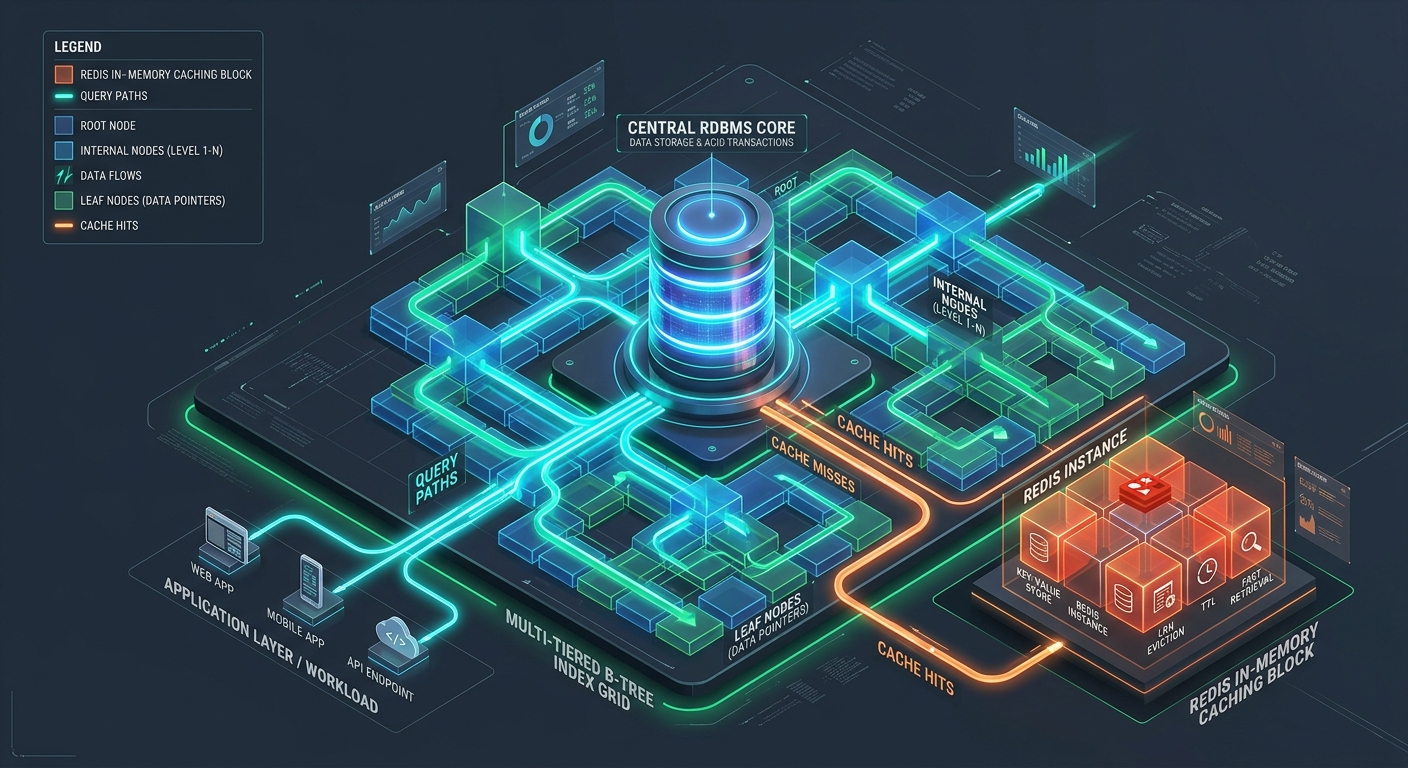
Indexing shifts database execution speeds from slow linear sequential scans down to logarithmic B-Tree lookups. However, over-indexing introduces heavy disk write overhead during record insertion and update operations.
SQL Query Optimization & Performance Tuning
Optimizing SQL performance involves identifying slow-running operations, reviewing query execution plans (EXPLAIN ANALYZE), and refactoring bad database access patterns.
SQL
-- Inefficient Query Pattern: Triggers a full table scan due to function execution on an indexed column
SELECT id, total_amount, created_at
FROM customer_orders
WHERE DATE(created_at) = '2026-09-02';
-- Optimized Query Pattern: Utilizes B-Tree index range scan over created_at index
SELECT id, total_amount, created_at
FROM customer_orders
WHERE created_at >= '2026-09-02 00:00:00'
AND created_at <= '2026-09-02 23:59:59';
- Eliminating Select-All Queries: Replacing SELECT * with explicit attribute fields to lower network payload size and reduce memory overhead.
- Resolving N+1 Query Bottlenecks: Replacing repetitive loop queries with optimized eager loading joins or parameterized WHERE IN (...) clauses.
- Keyset Pagination Execution: Replacing high-offset scanning (LIMIT 50 OFFSET 100000) with seek-based keyset pagination (WHERE id > last_seen_id LIMIT 50) for constant-time query speed.
High-Throughput Memory Caching & Buffer Optimization
To maintain high transaction speeds during load spikes, enterprise systems deploy specialized caching layers in front of physical database engines.
- In-Memory Caching (Redis / Memcached): Offloading frequent read lookups to fast, key-value memory stores to deliver sub-millisecond API response times.
- Engine Buffer Pool Optimization: Allocating maximum system RAM to engine buffer pools (such as MySQL InnoDB Buffer Pool or PostgreSQL Shared Buffers) to keep active indexes and data pages cached in memory.
- Automated Cache Invalidation: Configuring cache eviction protocols (TTL or publisher-subscriber invalidation triggers) to ensure application clients receive accurate real-time data.
Partnering with Reach Script Agency for Data Architecture
Designing and scaling enterprise database systems requires specialized backend software engineering expertise. Reach Script Agency provides end-to-end Custom Database Design Services, providing performance audits, SQL refactoring, custom schema design, and cloud database migration for enterprise systems.